QTE model
Analysis
Predict

Abstract of QTE model

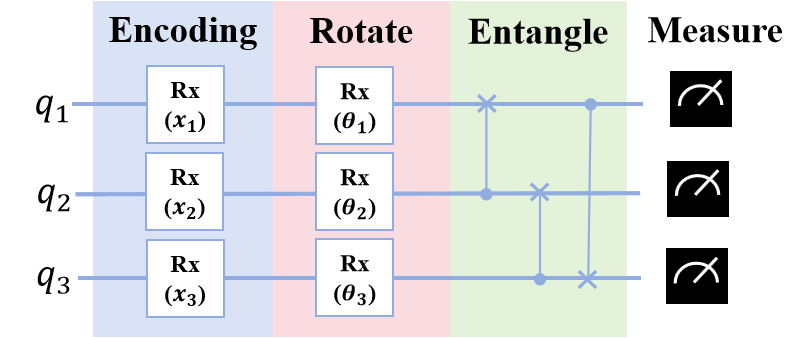
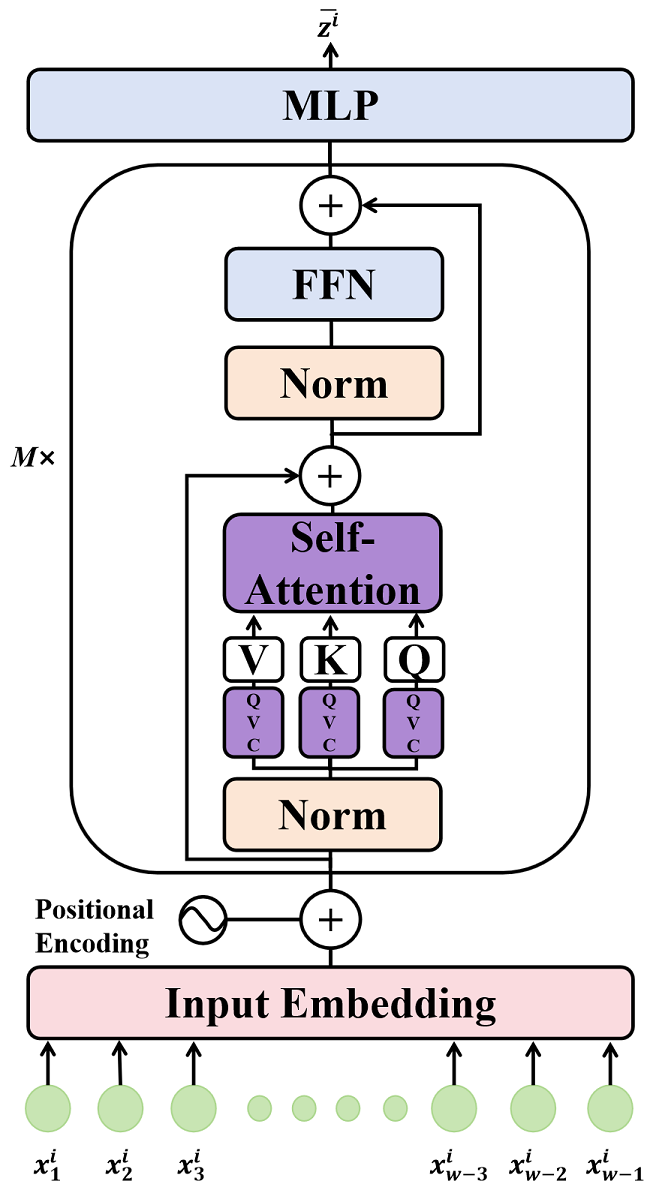
This study proposes the QTE model to achieve biological time series prediction. This model takes biological time series data as input and sequentially passes through embedding layers, quantum encoding layers, and multilayer perceptrons to output prediction results. Compared with the TE model based on classical multi head attention mechanism, the QTE model uses Variational Quantum Circuit (VQC) instead of multi head attention mechanism in the encoding layer.

The architecture of VQC
The architecture of QTE model

(1) Embedded layer:Firstly, this layer takes biological time series data as input, maps each step sequence data to a dimensional state space through embedding, and outputs the embedded biological time series data. Secondly, this layer assigns temporal features to the input biological time series based on the position of vectors in the sequence and the dimension of each value in the vector, and adds positional encoding to each token. Finally, the input data is added to the positional encoding to obtain the input for the quantum encoding layer;
(2) Embedded layer:The quantum coding layer is composed of a stack of coding layers, each consisting of a quantum attention layer and a fully connected layer. Quantum attention layer: This module uses layer normalization to obtain normalized data. Then, by using VQC to replace the query matrix, key matrix, and value matrix in the classical multi head attention mechanism, the results of quantum multi head attention can be calculated. Finally, use residual connections to output the results;
(3) Multilayer perceptron:In the multi-layer perceptron of the encoder, we use the classical fully connected layer and the classical GELU activation function to output the final prediction result.
QTE model
Performance analysis

We analyzed the prediction performance of the Qtransformer model on proteomics data. Proteomics time - series data exhibits a complex and dynamic time - varying behavior pattern. Its oscillation trend is not only obvious, but also not a simple linear change; instead, it contains complex nonlinear dynamics.Correspondingly, as a classic model in dynamical systems theory, the nonlinear pendulum can capture and describe the periodic or aperiodic oscillation characteristics of system states over time. This is very similar to the unstable oscillation phenomena we have observed in protein expression patterns.

Input the degree of nonlinear degree

Input the degree of noisy complexity

Input the dimension of prediction

There is no analysis.

Analysis Results
Predict on Qtransformer

Upload biological time series data (including genomic, proteomic, and metabolomic time profiles) to conduct high-precision temporal pattern prediction analysis using our specialized Quantum Transformer Encoder (QTE) architecture.

Input the dimension of prediction


There is no file.

Predictive Results