STNN model
Analysis
Predict

Abstract of STNN model

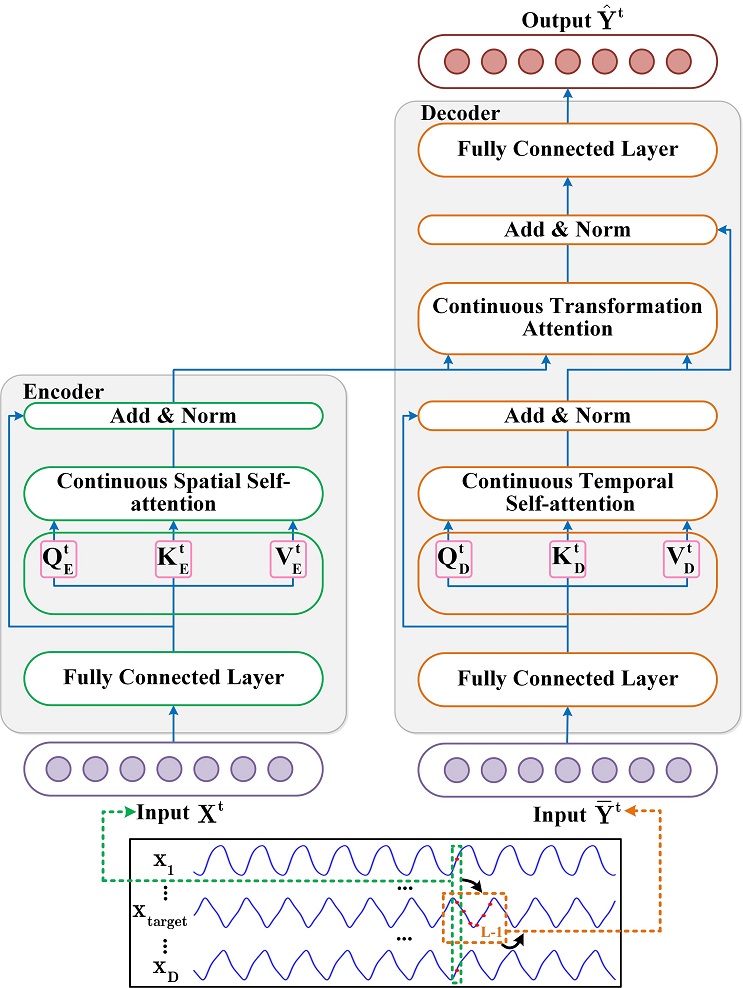
A model called STNN is used to achieve spatiotemporal information conversion. This model takes biological time series data as input and is constructed based on Transformer structure to effectively solve nonlinear STI transformation equations and achieve prediction of biological time series.

The architecture of STNN model

The STNN model uses spatiotemporal transformation equations and two specific transformer modules for multi-step prediction. One of the modules is the encoder, which takes biological variables as input.
Then, the encoder extracts effective spatial information from the input high-dimensional biological time series variables. Finally, the encoder transmits the spatial information of the biological data to the decoder. Another module is the decoder, which takes the time series of the predicted target variable as input.
Finally, the decoder extracts the temporal evolution information of the observed biological time series and predicts the future value of the target variable by combining the spatial information of the input variable with the temporal information of the predicted target variable.

STNN model
Performance analysis

We analyzed the prediction performance of the STNN model on proteomics data. Proteomics time - series data exhibits a complex and dynamic time - varying behavior pattern. Its oscillation trend is not only obvious, but also not a simple linear change; instead, it contains complex nonlinear dynamics.Correspondingly, as a classic model in dynamical systems theory, the nonlinear pendulum can capture and describe the periodic or aperiodic oscillation characteristics of system states over time. This is very similar to the unstable oscillation phenomena we have observed in protein expression patterns.

Input the degree of nonlinear degree

Input the degree of noisy complexity

Input the dimension of prediction

There is no analysis.

Analysis Results
Predict on STNN

Upload biological time series data (including genomic, proteomic, and metabolomic time profiles) to conduct high-precision temporal pattern prediction analysis using our specialized Spatio-Temporal Neural Network (STNN) architecture, which incorporates attention mechanisms for capturing complex temporal dependencies and spatial correlations in data.

Input the dimension of prediction


There is no file.

Predictive Results