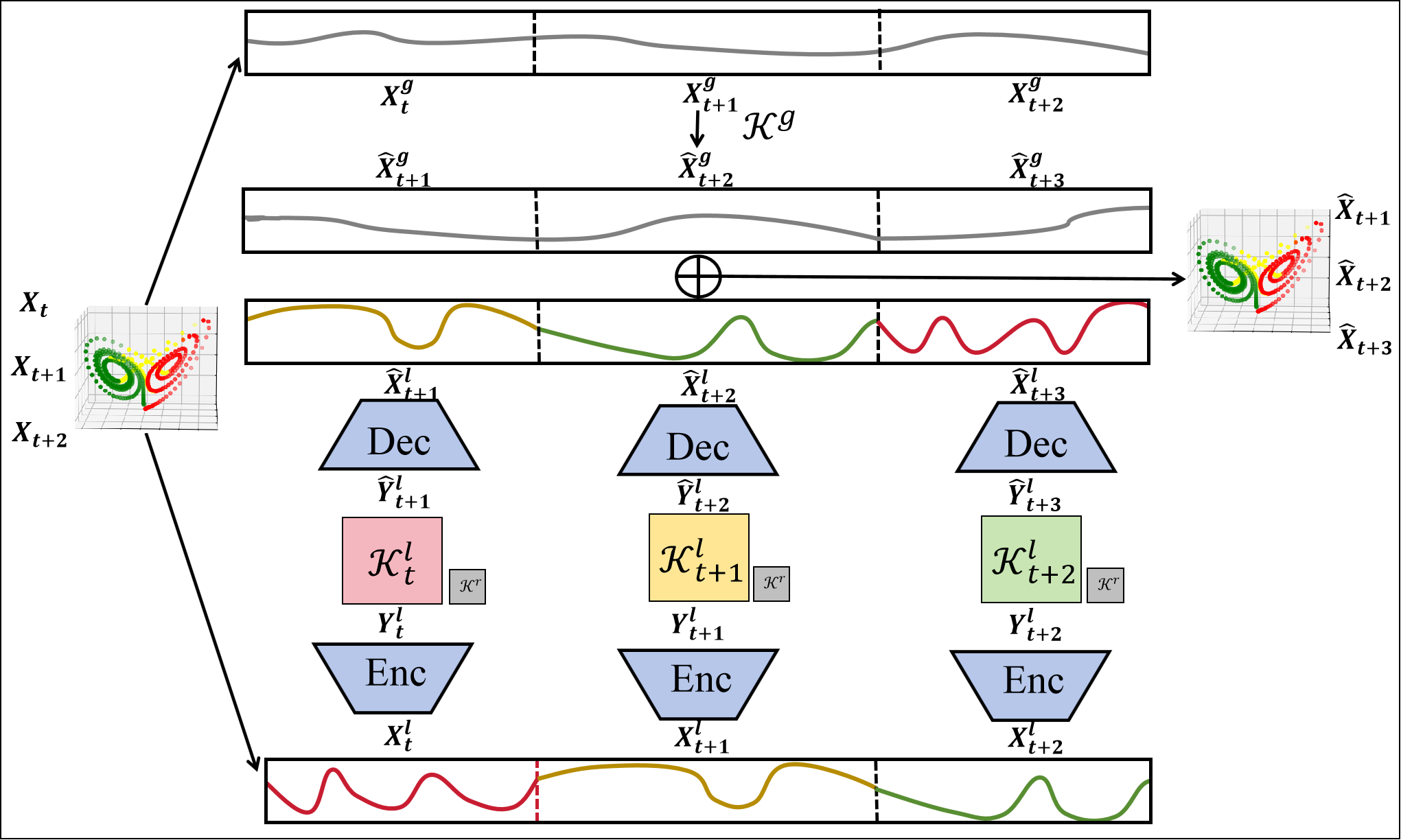
The architecture of TVNN model
(1) Data segmentation and decomposition:In time series data of biological systems, low-frequency global patterns represent the basic physiological state or long-term trend of the organism, while high-frequency time-varying patterns represent short-term physiological responses or fluctuations caused by external stimuli. We use Fourier filtering to perform frequency domain decomposition on each time period to obtain frequency domain statistics of the biological time series, and then decompose the low-frequency global patterns and high-frequency time-varying patterns in the time series;
(2) Global prediction module:The low-frequency global pattern in the evolution of biological systems refers to the changes and responses that occur over a longer time scale, involving macro processes such as species succession, community reorganization, and functional transformation of ecosystems. Reconstructing low-frequency global patterns can reveal the inherent laws of biological systems during long-term evolution. We use a pair of encoder decoder to project the observed data into a high-dimensional measurement space, and use the linear Koopman operator of global mode to deduce the evolution of low-frequency global trajectories;
(3) Time varying prediction module:High frequency time-varying patterns refer to the changes and responses that occur in biological systems on a short time scale, which involve microscopic and mesoscopic processes such as physiological activities of individual organisms and interactions between organisms. Reconstructing low-frequency global patterns can reveal the local time-varying trends of time-varying biological systems over long time scales. We use an encoder to project the observation function onto a high-dimensional measurement space.Then, our time-varying prediction module uses the dynamic mode decomposition algorithm to calculate the Koopman operator for each high-dimensional measurement data, and uses this operator to achieve the evolution of high-frequency time-varying trajectories.In addition, there are residuals in the reconstruction process of time-varying modes. Therefore, we introduce a learnable Koopman residual matrix to dynamically adjust and optimize the errors in the reconstruction process, in order to compensate for the errors in system modeling and the interference experienced by the system in actual situations, thereby improving the accuracy of reconstruction.Finally, we use a decoder to project high-dimensional measurement space data back into the measurement space to achieve reconstruction of the measurement data. At the same time, in order to ensure that the decoder can reconstruct the evolved state of the Koopman operator to improve the generalization of the prediction model, the decoder can project the evolved high-dimensional measurement space data back into the measurement space to achieve the reconstruction of the measurement data;
(4) Combining modules:By combining the outputs of the global prediction module and the time-varying prediction module, we can achieve the evolution process of the observed data.